
By Hari Reed, Policy & Advocacy Coordinator
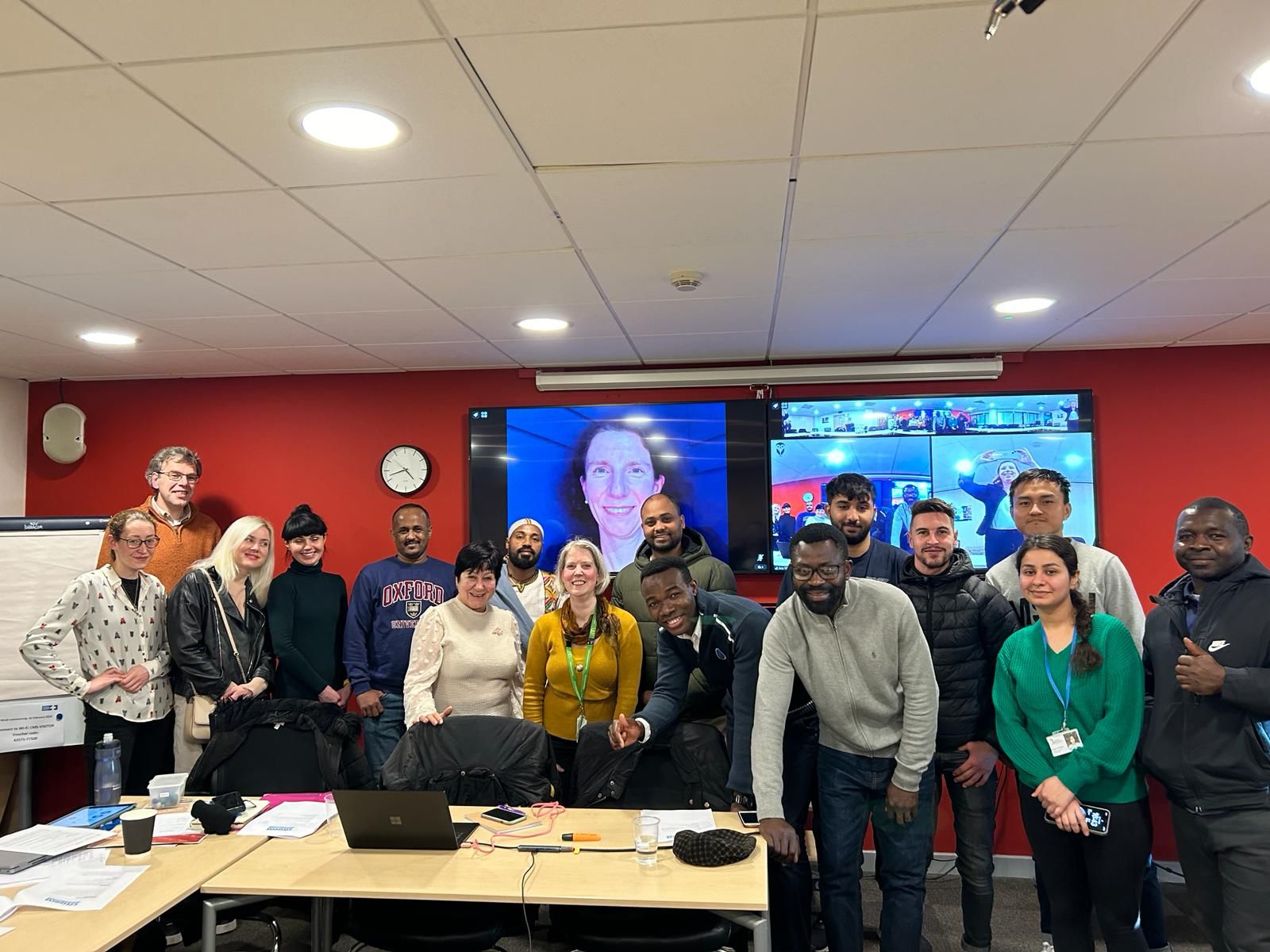
On 1st March, a group of 13 refugees and asylum seekers presented Anneliese Dodds MP with a bike lock.
Why?
First: it’s useful. Second: we know she is supportive of Asylum Welcome’s bike scheme. Third: we lock up our bikes to keep them safe. When we care about something, we don’t simply give it up. We do everything in our power to protect it. It’s what anyone would do.
Six months ago, a group of service users began the ‘five steps to social change’ training programme with Citizens UK. The course covered communication and storytelling; public engagement and awareness-raising; civic participation; and identifying, designing and implementing a local campaign to achieve a shared goal.
Using the skills developed through this training, the group addressed their MP, Anneliese Dodds, on ten different topics: the situation in asylum hotels; the asylum application process; the legal aid crisis; detention and removal; ESOL and the right to work; medical access; and transport.
The situation in asylum hotels
Our conversation began and ended with the situation in Oxford’s asylum hotel. The first speaker shared difficulties relating to room sharing, overcrowding, social isolation and the poor mental health of residents. The next speaker shared their concerns about the evictions currently taking place following a positive grant of refugee status. She asked whether the MP would support increasing the move-on period in hotels from 28 days to 56 days.
Dodds confirmed that she too was concerned when the hotel occupancy rate increased; she has raised the issue of room-sharing directly with the Home Office before and will continue to do so.
The asylum application process
Testimony about living in the asylum hotel was followed up with stories about the hostility, confusion and duration of the asylum application process. One individual explained that his first asylum interview, scheduled one year ago, had been cancelled and rescheduled recently, only to be cancelled a second time at the last minute. Another person described the problems stemming from incorrect paperwork and documentation sent by the Home Office.
The MP said her casework team will try to support those who need support with Home Office procedural issues. However, doing so has become harder after service standards were removed.
Legal aid
The next speaker shared a powerful account of trying to find legal representation for almost a year. The failure to find a lawyer to take on his asylum case has, he explained, led to insomnia and anxiety.
The MP acknowledged that legal aid has been cut very significantly over the past few years and that replacing it would be expensive. Whilst the cost of reinstating legal aid means it is not a commitment the Labour Party has made, Dodds would be supportive of a Law Centre being established in Oxford.
Detention and removal
Next, an individual who received a ‘notice of intent to remove’ to Rwanda described the fear and uncertainty of being in legal limbo. He asked whether his MP supported or opposed to plan to send asylum seekers to Rwanda. This question did not receive a response.
The subsequent speaker has been held in multiple detention centres, including Campsfield IRC in Oxford when it was open. He shared a number of his experiences in immigration detention and asked whether Dodds would speak out against the reopening of Campsfield, and/or support alternatives to immigration detention.
Dodds emphasised her belief that the root problem with detention is the waiting times for processing cases. She commented that people should not be in limbo for so long and that, were Campsfield to open, her casework team would be available to support with individual issues.
English Language and the Right to Work
The next speaker explained that he is a qualified care worker – one of the skills shortage occupations – and that he believes many of the problems in asylum hotels could be resolved if refugees had the unrestricted right to work earlier in the asylum process. He asked whether his MP would support this; he did not receive an answer.
His colleague went on to express a shared sense of frustration and confusion at the six-month delay in accessing English Language provision for asylum seekers. He made a compelling case for starting this language provision earlier. Dodds acknowledged that the arguments made about the six-month waiting periods were good ones, and said she would be happy to look into whether this could be accelerated.
Medical Access
Two speakers described the problems they had faced accessing doctors and dentists, even in emergencies. Dodds responded that constituents who experience continued barriers to healthcare could contact her casework team.
Transport
Finally, our last speaker described some of the barriers created by the cost of public transport for asylum seekers who receive £8-a-week. He gave the example of having to stop attending a free university course because he could not afford to get there. He pointed to other areas across the UK where transport has been made free for refugees. Dodds committed to look into this and to write to Oxford Bus Company if appropriate.
The inaccessibility of public transport – and hence of the world outside the hotel – is the issue the group has chosen to campaign on locally. Watch this space for the next stages of this campaign, or get in touch if you can think of ways to drive this campaign forward!

